6,500 Years of Solitude? Investigating Pottery from Pheneos
Since October 2021, research has been ongoing as part of the FWF project, “6,500 Years of Solitude? Investigating Pottery from Pheneos” (FWF individual project no. P 34385), which is a follow-up to the first FWF project from 2017 to 2021. Building on the foundations laid in this previous project, “Pheneos in Northeastern Arcadia - An Undiscovered Town”, the current project aims to identify and characterise the local production of pottery, distinguishing it from regional and supra-regional imports throughout the settlement hill's entire usage period, from the Neolithic to the early Modern Era. While established archaeological methods are employed, including classifying the ceramic finds into macroscopic fabric groups, the FWF project facilitates the verification and supplementation of the results obtained in this way by means of scientific methods.
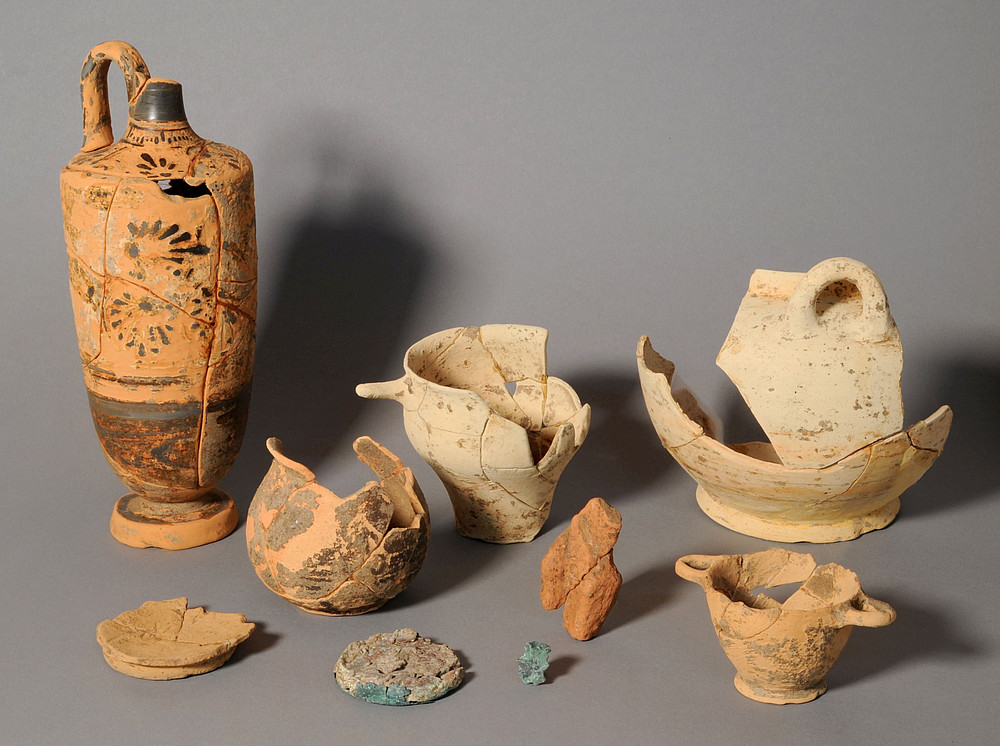
Selected Neolithic, Bronze Age, historical and post-antique samples are examined using petrographic thin-section analysis, SEM-EDS analysis and NAA. The University of Patras, under the direction of Ioannis Iliopoulos, has conducted geological surveys of the basin to reliably link findings about the employed raw materials with the Pheneos Valley. In this way, we will be able to draw conclusions about the persistence of local production and, for the first time, gain insight into the socio-economic situation of the area. Thus, it becomes possible to depict both change and continuity over the centuries, both in regard to the places of origin of the pottery that came to Pheneos from outside the valley, as well as to local techniques and vessel shapes.
Pheneos in Northeastern Arcadia - An Undiscovered Town
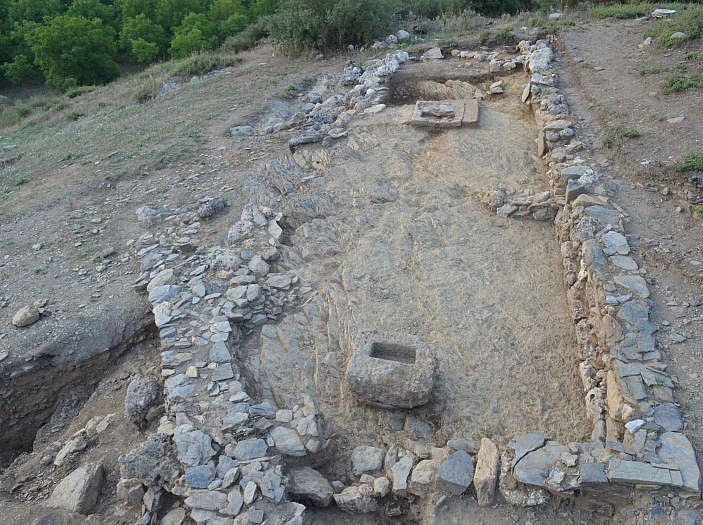
Funding for processing the finds began in 2017 with the approval of the first FWF project, entitled “Pheneos in Northeastern Arcadia – An Undiscovered Town" (FWF Individual Project No. P 30446) and directed by Elisabeth Trinkl. This facilitated an initial recording and categorisation of finds, enabling us to classify more precisely the features from the excavations and to roughly date individual entities. By the time the project ended in autumn 2021, it had become clear that the intensive use of the hill throughout the 1st millennium BC can be attributed to the existence of several sanctuaries. In the Middle Ages and Modern Era, the eastern plateau, on which a church stands today, was partially used as a cemetery, possibly close to a predecessor of the modern church.
In addition, the dating of the fortification wall was clarified. According to the pottery from the foundation area, it was probably built in the early 3rd century BC. However, human activity on the hill of Pheneos can be traced back to the Neolithic period, continuing almost without interruption until the Hellenistic period, particularly intensively in the Middle Helladic period. Careful examination of the pottery also provided the indications of locally produced vessels, enabling us for the first time to draw conclusions about Pheneos’ economic connections and living circumstances in prehistoric and historical times.
Five-year research cooperation
The five-year research collaboration (2011–2015) between the 37th Ephorate of Prehistoric and Classical Antiquities in Corinth and the OeAI at Athens, represented by the University of Graz, aimed to uncover the ancient fortification wall on the northern side of the hill, following the cleaning campaign from 2008/2009. The project sought to clarify the course of the wall and continue the investigation of the towers and search for a possible gate. Once the excavation work had been completed in 2015, annual research visits to Pheneos were dedicated exclusively to processing the finds.
Since 2016, the extensive pottery and bronze finds, as well as the bone and stone artefacts, from the excavations on the fortification wall have been documented and studied during annual museum campaigns. This has resulted in several master's and doctoral theses. A comprehensive publication of all the excavation results in several volumes is planned for the 2020s.